
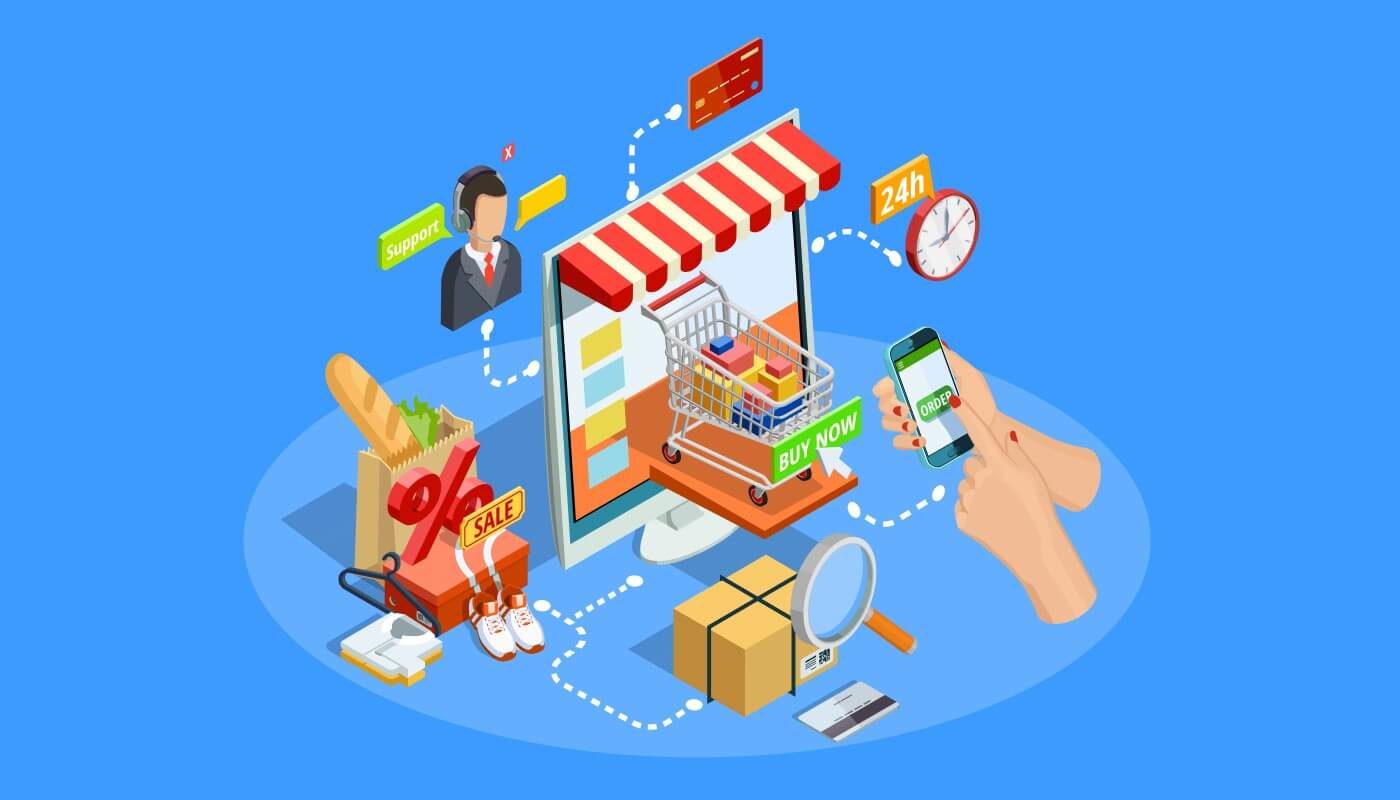
History and Definitions of E-commerce
Electronic Data Interchanges and teleshopping in the 1970s paved the way for the modern day ecommerce store. The history of ecommerce is closely intertwined with the history of the internet. Online shopping only became possible when the internet was opened to the public in 1991. Online shopping was invented and pioneered in 1979 by Michael Aldrich in the United Kingdom. He connected a modified domestic television via a telephone line to a real-time multi-user transaction processing computer.
It may be now that online shopping has become popular but the concept of e-Commerce was introduced long back in the 20th century.
India first came into interaction with the online E-Commerce via the IRCTC. The government of India experimented this online strategy to make it convenient for its public to book the train tickets. Hence, the government came forward with the IRCTC Online Passenger Reservation System, which for the first time encountered the online ticket booking from anywhere at any time.
‘E-commerce’ and ‘online shopping’ are often used interchangeably but at its core e-commerce is much broader than this – it embodies a concept for doing business online, incorporating a multitude of different services e.g. making online payments, booking flights, purchasing goods and services etc. This means that whenever you buy and sell something using the Internet, you’re involved in ecommerce.
Why Do People Buy ‘Online’?
Lower Prices: Managing an online storefront is far cheaper than an offline, brick and mortar store. Typically less staff are required to manage an online shop as web-based management systems enable owners to automate inventory management and warehousing is not necessarily required. Furthermore, with the rise of price comparison websites, consumers have more transparency with regard to prices and are able to shop around, typically purchasing from online outlets instead.
Accessibility and Convenience: Consumers can access e-commerce websites 24 hours a day. Customers can read about services, browse products and place orders whenever they wish and from wherever they wish too at a touch of a button. Online shopping is extremely convenient and gives the consumer more control.
Wider Choice: With an almost endless choice of brands and products to choose from, consumers are not limited by the availability of specific products in their local town, city or country. Items can be sourced and shipped globally.
Classification of E-commerce
1. Business to consumer (B2C): Transactions happen between businesses and consumers. In B2C ecommerce, businesses are the ones selling products or services to end-users i.e. consumers. Online retail typically works on a B2C model.
Example : Flipkart , Myntra
2. Business to business (B2B): B2B ecommerce pertains to transactions conducted between two businesses. Any company whose customers are other businesses operate on a B2B model.
Example: An online accounting software for small businesses, Payroll processing company etc.
3. Consumer to business (C2B): Consumer to business ecommerce happens when a consumer sells or contributes monetary value to a business.
Example: Resourcing manpower in bulk
4. Consumer to consumer (C2C): C2C ecommerce happens when something is bought and sold between two consumers. C2C commonly takes place on online marketplaces such as barter, in which one individual sells a product or service to another.
Example: OLX
5. Government to business (G2B): These transactions take place when a company pays for government goods, services, or fees online. Examples could be a business paying for taxes using the Internet.
Example: MSED, Adani Power etc.
6. Business to government (B2G) – When a government entity uses the Internet to purchases goods or services from a business, the transaction may fall under B2G ecommerce. Let’s say a city or town hires a web design firm to update its website. This type of deal may be considered a form of B2G.
7. Consumer to government (G2C) – Consumers can also engage in B2C ecommerce. People paying for traffic tickets or paying for their car registration renewals online may fall under this category.
Why Do Businesses Sell ‘Online’?
Higher Margins: Setup costs and ongoing operational costs such as rent, electricity, warehousing (if operating a drop-ship model) and inventory management are often significantly reduced or otherwise eliminated. Further, customer service and other administrative tasks can be automated or outsourced at a relatively low-cost. As such, higher margins can usually be achieved when selling via an online store compared to operating an offline business.
Scalability: There is no limit when trading online. Running an e-commerce business means tapping into a truly global market. Online platforms enable rapid scaling. With the emergence of social media and content marketing as well as the option of generating traffic and conversions through pay-per-click (PPC), expanding into new regions or markets can happen quickly.
Consumer Insight / Technology: E-commerce businesses typically collate a tremendous amount of customer data. With every element of consumer behaviour being tracked, e-commerce business owners are able to understand, tweak and improve the customer shopping experience for customers. With technology rapidly evolving, it is important that online retailers use tools such as Google Analytics correctly to understand their customers’ buying habits, unlocking insight from this data presents a unique advantage, not available to offline stores. Those who leverage the right systems and technology can see their businesses grow extremely quickly.
E-Commerce Models
There are three main fulfilment models. These models have a significant impact on the operational characteristics of the business and its day-to-day running as well as the overall operating margin. The three main models are:
1) Dropshipping Model
In a dropshipping model, the e-commerce business takes no physical possession of the items on sale. The store owner does not keep products in stock and there is no inventory held. Instead, orders are sent directly to the manufacturer, who is responsible for storing the items and shipping them to the customer. In this sense, the merchant never sees or touches the products, which has some unique advantages over adopting a more traditional order fulfilment model.
2) Traditional Order Fulfilment Model
Buying wholesale is arguably closest to the traditional offline retail model. In effect, the business owner (retailer) acquires stock directly from a wholesaler at a discounted rate, applies a margin onto each product and decides to deliver to consumers directly.
Benefits of Dropshipping vs. Traditional Order Fulfilment:
i) Eliminates Inventory Risk: One of the biggest drawbacks of running an offline retail business or a non-dropship e-commerce business is the fact that inventory has to be acquired upfront. Naturally, buying stock costs money and with no 100% guarantee of being able to sell it, there is an inherent risk to the business owner. Drop-shipping however, does not generally require any upfront investment in inventory.
ii) Less Time / Lower Ongoing Costs: Shipping products requires time of owner not only for ordering but also managing the stock, nsuring optimal stock control at all times to avoid turning away orders, all of which can be avoided with a drop-shipping model.
iii) Product Flexibility: If dropshipping, as a retailer, you have the flexibility to try out new product lines in your online store and sales channels which enables business owners to ‘go to market’ more quickly – an attractive proposition if looking to secure market share for a unique e-commerce value proposition.
3) Outsourced Fulfilment Model
The retailer may want to avoid end-to-end fulfilment (like the traditional model), then a hybrid approach can be adopted – using a ‘fulfilment house’. In this model, few assigned companies are commissioned to handle the product side of the business, on behalf of the retailer. Generally, they are responsible for collecting products from the supplier, holding the product at their distribution centers, all packaging as well as onward order fulfilment (to the customer). This service comes at a cost – minimum fees, return fees and setup fees are commonplace and should be fully weighed up beforehand.
Conclusion
eCommerce is continuously progressing and is becoming more and more important to businesses as technology continues to advance and is something that should be taken advantage of and implemented. E-business is creating new opportunities for companies willing to adapt.
